Australian businesses are becoming increasingly willing to pay ransomware demands, with new research from professional services firm McGrathNicol revealing that 78% of organisations that experienced a ransomware attack ultimately paid their attackers.
The findings come from the McGrathNicol Ransomware Survey 2026, which is a great insight into the ransomware decisions by Australian businesses and captures the views of 1,000 decision-makers from these businesses employing 50 or more people.
The survey highlights the growing financial consequences of ransomware, increasing pressure on organisations to make rapid decisions during an incident, and concerns about whether businesses are adequately prepared to manage the negotiation, recovery and reporting processes that follow an attack.
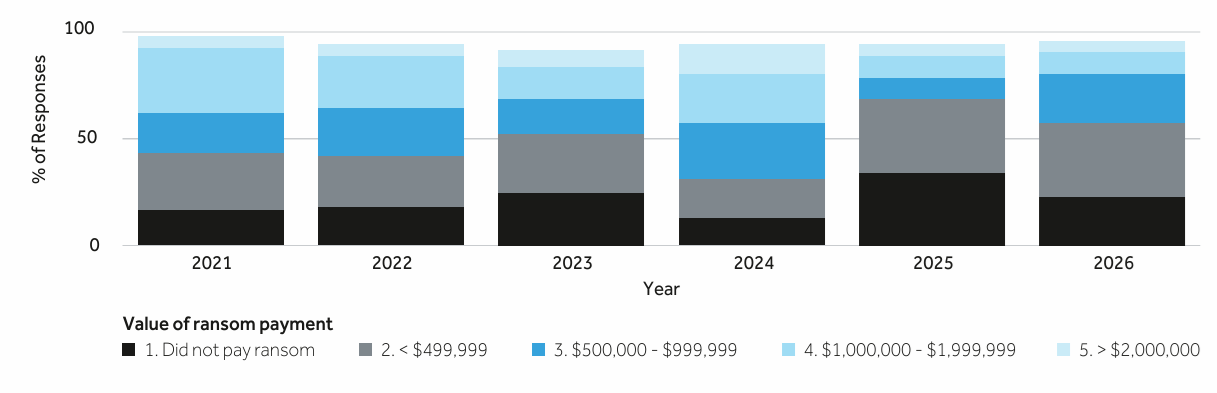
One of the most significant findings is the increase in organisations choosing to pay. The proportion of ransomware victims paying a ransom rose from 64% in 2025 to 78% in 2026. The average estimated ransom payment also increased, reaching $794,000, compared with $711,000 in the previous year’s survey.
The findings suggest that despite increased awareness of ransomware and investment in cyber security, many organisations remain vulnerable to the pressure exerted by threat actors once an attack has disrupted their operations.
Key findings from the 2026 survey
| Survey finding | 2026 result | Previous result |
|---|---|---|
| Ransomware victims that paid a ransom | 78% | 64% in 2025 |
| Average estimated ransom payment | $794,000 | $711,000 in 2025 |
| Organisations paying within 24 hours | 40% | 29% in 2025 |
| Organisations willing to pay a cyber ransom | 84% | 81% in 2025 |
| Victims that paid without negotiating | 41% | 31% in 2025 |
| Organisations with cyber insurance | 93% | — |
| Average cyber insurance coverage | $960,000 | Continuing decline since 2024 |
| Respondents who believe SMEs are more vulnerable to ransomware | 82% | — |
Increasing pressure to pay
The increase in ransom payments is particularly concerning, with nearly four in five organisations that experienced an attack ultimately deciding to pay.
The speed at which organisations are making these decisions is also increasing. Among businesses that paid a ransom, 40% made the payment within 24 hours, an increase of 11 percentage points from 2025.
Furthermore, 41% of organisations that experienced an attack in the past five years and decided to pay said they did not negotiate before making the payment. This compares with 31% in 2025.
The results point towards an increasingly pressured decision-making environment, where organisations may feel they have limited time to consider their options, assess the consequences of payment or engage specialist incident response and negotiation support.
SMEs face a growing ransomware resilience gap
The report also highlights concerns around the vulnerability of small and medium-sized enterprises (SMEs).
More than four in five respondents (82%) believe SMEs are more vulnerable to ransomware attacks than larger organisations. The primary challenges identified include a lack of dedicated cyber security personnel (37%), limited technical expertise (35%) and constrained cyber security budgets (35%).
The report also found that businesses with annual turnover below $50 million were more than twice as likely to have been successfully breached by ransomware over the past five years than businesses with turnover above $50 million (38% compared with 17%).
This highlights an ongoing challenge for smaller organisations, which may have some security technology and incident response arrangements in place but lack the internal expertise and resources required to effectively manage a major cyber incident.
Cyber insurance remains widespread, but coverage is declining
Cyber insurance remains prevalent among Australian businesses, with 93% of surveyed organisations reporting that they have insurance coverage.
However, the average coverage amount has declined since 2024, reaching $960,000 in the latest survey.
Despite the widespread availability of insurance, the report suggests that insurance alone does not necessarily translate into better incident outcomes. Organisations still need to understand their policy conditions, reporting obligations, recovery requirements and the extent to which ransom payments may be covered.
Interestingly, 84% of businesses said they would be willing to pay a cyber ransom if they were attacked, up from 81% in 2025.
The average amount executives said they would be willing to pay was approximately $850,000, demonstrating the extent to which businesses are prepared to consider significant financial payments to restore operations or prevent further harm.
Threat actors are increasing pressure on victims
One of the more concerning observations in the report relates to how ransomware operators are changing their approach to communicating with victims.
According to McGrathNicol, threat actors are becoming less willing to wait while an organisation decides whether to communicate or negotiate.
In multiple ransomware incidents investigated by the firm, attackers have gone beyond established communication channels and directly contacted employees or other individuals connected to the victim organisation.
The apparent objective is to provoke engagement and create additional pressure on decision-makers.
This is an important development for organisations preparing their incident response and crisis communications procedures. Ransomware negotiations are no longer necessarily confined to a designated email address or communication channel between the attacker and the organisation.
Threat actors may attempt to bypass established processes by contacting employees through messaging platforms, email or other channels, potentially increasing confusion and pressure during an already difficult incident.
Organisations should therefore have clear internal instructions for employees who receive direct contact from threat actors, including how to escalate communications, preserve evidence and avoid engaging independently.
Having an incident response plan is not enough
A key conclusion from the report is that many Australian organisations have invested in cyber insurance, incident response plans and governance frameworks, but are not regularly testing their ability to make decisions and execute those plans under pressure.
In 2026, 88% of business leaders considered their organisation prepared to respond to a cyber attack. However, this was down from 96% in 2025.
McGrathNicol suggests that organisations need to move beyond simply having documented plans and ensure they are regularly tested through realistic ransomware exercises.
This should include testing:
- Who has authority to make ransom payment decisions.
- How negotiations with threat actors will be managed.
- How cyber insurers, legal advisers and incident responders will be engaged.
- How customers, employees, regulators and other stakeholders will be notified.
- Whether backups and recovery procedures can restore critical operations without relying on the attacker providing a working decryption key.
- How employees should respond if threat actors contact them directly.
- How the organisation will manage data theft, public disclosure and operational disruption simultaneously.
The report also highlights Australia’s ransomware payment reporting obligations under the Cyber Security Act 2024, with 92% of business leaders aware of the reporting requirements. However, only 30% described themselves as very familiar with the framework.
For organisations covered by the legislation, ransomware payments must be reported within 72 hours of becoming aware of the payment.
About McGrathNicol
McGrathNicol is an Australian professional services and advisory firm specialising in cyber security, digital forensics, incident response, corporate advisory, restructuring and risk management.
The firm works with organisations across the private and public sectors, providing support during complex business, financial and cyber security incidents.
Its Technology and Cyber team provides services including digital forensic investigations, cyber incident response, threat intelligence, security assessments, crisis management and recovery support.
The 2026 report is the firm’s sixth annual ransomware survey, tracking changes in Australian business attitudes and experiences relating to ransomware attacks, ransom payments and incident reporting.
Read the full report
The full 2026 McGrathNicol Ransomware Report – Under Pressure: Why Prepared Organisations Are Still Paying Cyber Ransoms is available here:
Download the McGrathNicol 2026 Ransomware Report (PDF)