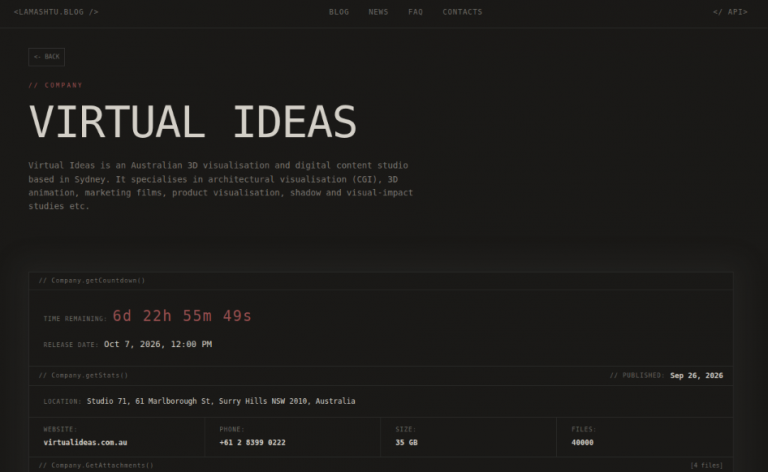
The Lamashtu Group has claimed an Australian victim, with Australian 3D visualisation and digital content studio Virtual Ideas (virtualideas.com.au) reportedly added to the group’s victim list.
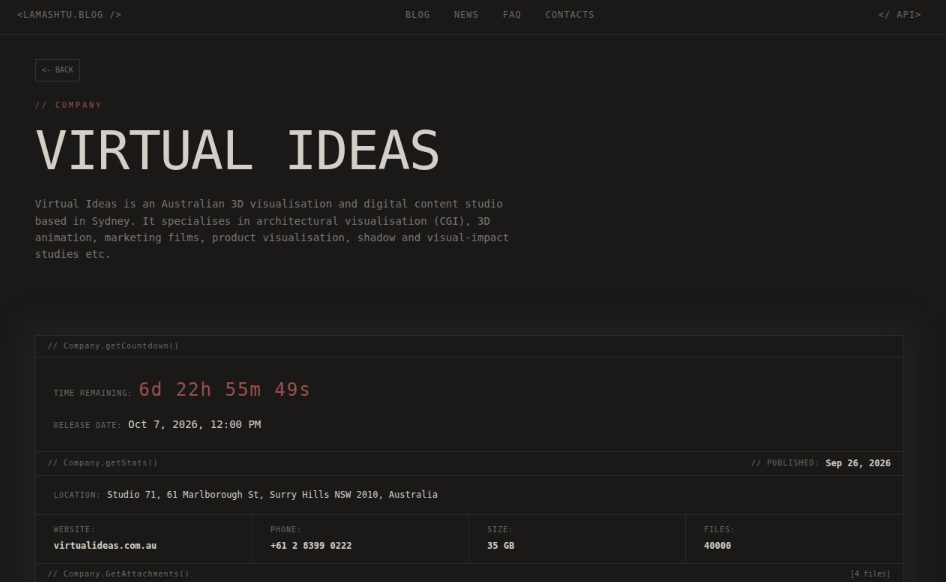
Virtual Ideas operates from Sydney and provides services including architectural visualisation, CGI, 3D animation, marketing films, product visualisation, and visual-impact studies. Multiple ransomware monitoring services now list Virtual Ideas as a Lamashtu victim, with the listing appearing on 26th of September 2026.
For ThreatIntel.co.nz, this is the first known Lamashtu victim identified in Australasia.
40,000 files and 35GB allegedly stolen
According to information observed by ThreatIntel.co.nz, Lamashtu is threatening to release approximately 40,000 files totalling 35GB of data on 7 October 2026.
The group allegedly claims the information was obtained from a network storage device, with the data reportedly spanning active Virtual Ideas projects from 2023 through to 2026.
The alleged data includes:
| Data type | Potential information |
|---|---|
| Tender submissions | Commercial proposals and project bids |
| Financial administration | Internal financial and administrative records |
| Tax documentation | Business tax-related information |
| Invoice records | Customer and supplier financial records |
| Project information | Material relating to active projects between 2023–2026 |
ThreatIntel.co.nz has not independently verified the claimed compromise, the volume of data, the alleged source of the information, or the contents of the files.
The 7 October release date should therefore be treated as an extortion threat rather than confirmation that the data will be published.
The Lamashtu listing is nevertheless independently visible through several ransomware tracking services, which currently identify Virtual Ideas as an Australian Lamashtu victim.
Why the network storage claim is significant
The alleged compromise of a network storage device is worth watching.
Network-attached storage can contain large concentrations of business information, particularly within organisations involved in creative production, engineering, professional services and project-based work. Unlike an individual workstation, a shared storage environment can potentially provide access to information accumulated over many years.
In this case, the alleged 35GB of data covering projects from 2023 to 2026 would represent a significant concentration of historical and current business information if the claim proves accurate.
Tender documents, invoices, tax records and project material can also contain information extending beyond the victim organisation itself, potentially involving customers, suppliers, contractors and other third parties.
That makes the incident potentially relevant beyond Virtual Ideas if the claimed data is subsequently released.
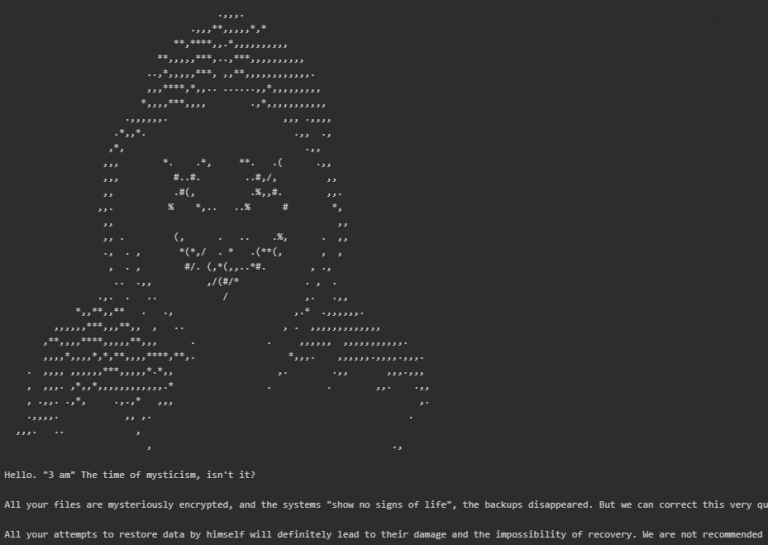
Who is Lamashtu Group?
Lamashtu Group is a relatively recent ransomware and data-extortion operation. Public ransomware tracking currently shows the group with victims across multiple countries and sectors, with activity dating back to at least April 2026. Its reported victims include organisations in manufacturing, technology, healthcare, transportation, professional services, hospitality and retail.
Recent reported victims include:
- Becker Logistik — Germany
- Great Foods — Egypt
- Pataya Food Group — Thailand
- Shan Poornam Metals — India
- Malaysia Smelting Corporation — Malaysia
- Sertes — Mexico
- IA International Assistance — Malaysia
- Seacare Hotel — Singapore
- IparBilbao Abogados — Spain
A large percentage of the victims are based in Europe but this could be skewed because of the new nature of the group.
More recent September activity shows the group continuing to add victims across Europe, Asia, Australia and the United States. Current ransomware monitoring lists Virtual Ideas alongside organisations including Becker Logistik, FIDUCIAL, PROJAHN and others.
Lamashtu’s apparent targeting profile
Available reporting suggests that Lamashtu has targeted a broad mixture of commercial and service-sector organisations.
Observed sectors include:
- Manufacturing
- Logistics and transportation
- Food and beverage
- Healthcare
- Retail
- Professional services
- Technology
- Hospitality
- Energy and utilities
This broad targeting makes it difficult to characterise Lamashtu as a specialist threat actor focused on one particular vertical.
Its victim activity instead appears consistent with an opportunistic ransomware and extortion model in which organisations with valuable business data can become targets.
Observed MITRE ATT&CK techniques
Available reporting associates Lamashtu activity primarily with ransomware impact and data theft:
| Technique | ID | Relevance |
|---|---|---|
| Data Encrypted for Impact | T1486 | Ransomware encryption of data to disrupt operations |
| Data from Local System | T1005 | Associated with theft of data from compromised systems |
At present, the available reporting does not establish a consistent CVE or malware dependency for Lamashtu. This is partly a consequence of the group’s relatively recent emergence and the limited amount of publicly available technical reporting.
Organisations should therefore avoid assuming that Lamashtu activity necessarily depends on a particular vulnerability or malware family.
What organisations should take from the incident
The reported Virtual Ideas incident is another reminder that data theft does not require an organisation’s most critical production system to be compromised.
A network storage device containing years of project information may provide an attacker with commercially sensitive information even if core business applications remain operational.
Organisations should therefore include file servers, NAS platforms and other shared storage environments within ransomware threat modelling and detection coverage.
Particular attention should be given to unusual authentication activity, new administrative accounts, unexpected access to large numbers of files, unusual data transfers and attempts to disable or interfere with backup infrastructure.
ThreatIntel.co.nz assessment
The Lamashtu claim against Virtual Ideas remains unverified by ThreatIntel.co.nz.
However, the victim listing is appearing across multiple ransomware monitoring sources, and Virtual Ideas is currently identified as an Australian Lamashtu victim.
If the claimed 40,000 files and 35GB are subsequently released on 7 October 2026, it should provide considerably more information about the nature of the intrusion, the data-accessed pathway and the extent of any compromise.
For now, the incident is best treated as a claimed ransomware/data-extortion attack, rather than confirmed evidence that all of the alleged data has been obtained or will be publicly released.