A significant third-party JavaScript supply-chain attack has seen malicious code injected into websites belonging to some of the world’s largest organisations, including the BBC, CNN, Zoom, Salesforce, HSBC, GitLab and numerous Australian and New Zealand businesses.
According to research published by Report URI, on 16 November 2026 malicious JavaScript was delivered to visitors across at least 178 organisations, through the Optimizely Web experimentation platform.
ThreatIntel.nz have observed local users being redirected to the malicious sites beginning at 10pm NZST on the 16th until 10am NZST on the 17th which lines up directly with the timeline in the report-uri.com article. Some of the New Zealand websites listed in the NZ table and not one of the confirmed 178 sites also appear to have been compromised, we have reached out to some of these companies and heard back that they were affected.
The attack is particularly concerning because the affected websites did not necessarily have to be compromised themselves. Instead, attackers abused trusted JavaScript code delivered through Optimizely, allowing malicious functionality to execute in visitors’ browsers while appearing to originate from a legitimate, trusted third-party service. Simply browsing the BBC or CNN websites was enough to compromise a user.
The incident demonstrates the risks associated with third-party JavaScript dependencies, particularly when organisations rely on external platforms to deliver code directly into customer-facing websites.
The big takeaway as report-uri.com states is “We don’t know how the attacker got write access to so many unrelated customer projects”
What did the malware do?
The injected JavaScript was a multi-purpose information-stealing and financial theft toolkit, with several capabilities designed to target website visitors.
Some of the key functionality included:
- Payment card theft: The malware monitored website form submissions and outgoing POST requests, looking for credit card numbers, expiry dates and CVV security codes. When all three were identified, the information was transmitted to attacker-controlled infrastructure.
- Cryptocurrency theft: The malware intercepted cryptocurrency wallet addresses displayed on websites and replaced them with addresses controlled by the attackers. This included modifying addresses in page content, form fields, links and clipboard operations.
- Session and cookie theft: Non-HttpOnly browser cookies were collected and transmitted to attacker infrastructure, potentially exposing session information that could assist with account compromise.
- Screenshot collection: The malware could capture screenshots of affected webpages and send them to the attackers.
- Mobile device exploitation: Visitors using iPhones and iPads were also targeted with the Coruna and DarkSword iOS exploit kits, depending on their iOS version.
The payment card functionality is particularly concerning for customers entering payment details directly into website forms. Report URI noted that payment information entered into hosted payment iframe environments, such as Stripe and Adyen, was outside the reach of this particular card-skimming functionality.
The cryptocurrency functionality presents a different risk. Rather than necessarily stealing wallet credentials, the malware could silently substitute a legitimate recipient’s wallet address with one belonging to the attackers. A customer copying an address to make a cryptocurrency payment could therefore unknowingly transfer funds directly to the threat actors.
This was not simply a theoretical capability. Report URI identified cryptocurrency transactions totalling approximately US$7,040 (which is not a large amount considering the scale of compromise) received by attacker-controlled wallets during the observed campaign.
Australian and New Zealand websites directly affected
The incident has a significant local dimension, with multiple Australian businesses and at least one New Zealand website appearing in Report URI’s list of affected organisations.
The following Australian and New Zealand domains were identified as directly affected:
| Organisation | Country | Affected domain |
|---|---|---|
| HSBC Australia | Australia | www.hsbc.com.au |
| Rest Super | Australia | rest.com.au |
| Compare Club | Australia | compareclub.com.au |
| Energy Scout | Australia | energyscout.com.au |
| Levi’s Australia | Australia | levis.com.au |
| TPG Telecom | Australia | www.tpg.com.au |
| Vodafone Australia | Australia | www.vodafone.com.au |
| Betashares | Australia | www.betashares.com.au |
| O’Brien Glass | Australia | www.obrien.com.au |
| Levi’s New Zealand | New Zealand | levis.co.nz |
These organisations span banking, superannuation, financial services, telecommunications, retail and other industries.
The presence of these domains in the affected list means visitors accessing them during the period in which the malicious JavaScript was being served may have been exposed to the malware.
It does not mean every visitor had their information stolen. The actual impact depended on factors including the timing of the visit, the device being used and whether the visitor performed actions targeted by the malware.
Some of the major international brands affected
The campaign was not limited to smaller websites or organisations with limited security resources. Report URI identified malicious JavaScript across websites associated with some very recognisable global brands.
Examples include:
| Sector | Affected organisations |
|---|---|
| News & Media | BBC, CNN, Fox News, NPR |
| Technology | Zoom, Salesforce, GitLab, Bitly |
| Banking & Finance | HSBC, Equifax, Paychex |
| Retail | IKEA, ASOS, Mattel, American Eagle |
| Cryptocurrency | Ledger, IG, OANDA |
| Airlines & Travel | Air France-KLM, Alaska Airlines |
| Telecommunications | Vodafone Australia, TPG Telecom, Virgin Media |
| Entertainment | Peacock, NOW TV, Wizards of the Coast |
Report URI identified 188 infected Optimizely JavaScript snippets belonging to 178 organisations during its investigation. Its researchers believe the actual number could be higher, as they were only able to examine snippets they had discovered.
Sample of New Zealand websites using Optimizely
In addition to the directly affected New Zealand domain listed above, a review of websites loading Optimizely JavaScript identifies a wider range of New Zealand-facing organisations and services using the platform.
The following is a sample of domains identified as using Optimizely. Inclusion in this table does not mean these websites were confirmed to have been infected during this campaign.
Sample of Australian websites using Optimizely
A similar review of Australian websites identifies a broad range of organisations using the platform, including major retailers, financial services, telecommunications providers, media organisations and universities.
Again, these are examples of websites using Optimizely and should not be interpreted as a list of confirmed victims of this particular incident.
Timeline
| Date / Time (UTC) | Event |
|---|---|
| September 17 | webshell.lol, the same actor’s JavaScript injector, first appears on Turkish websites through an SEO “backlink panel” script. |
| November 9 – 17:52 | 5vobauua3ojpklx.icu registered. This domain would later serve as an iOS exploit-kit router. |
| November 13–16 | Earlier injection wave: webshell.lol/get.js injected through Kissmetrics, StorifyMe and Minute Media scripts on websites including securitybank.com, faz.net, smh.com.au, vidaxl and foxsports.com. |
| November 16 – 02:21 | Last known clean urlscan capture of the BBC’s Optimizely JavaScript snippet. |
|
04:21
November 16 |
First observed Optimizely injection. The BBC’s Optimizely snippet is modified to load malicious JavaScript from webshell.lol. |
| 04:28–05:23 | TLS certificates issued for 1688360.cc, with the domain registered at 05:23. |
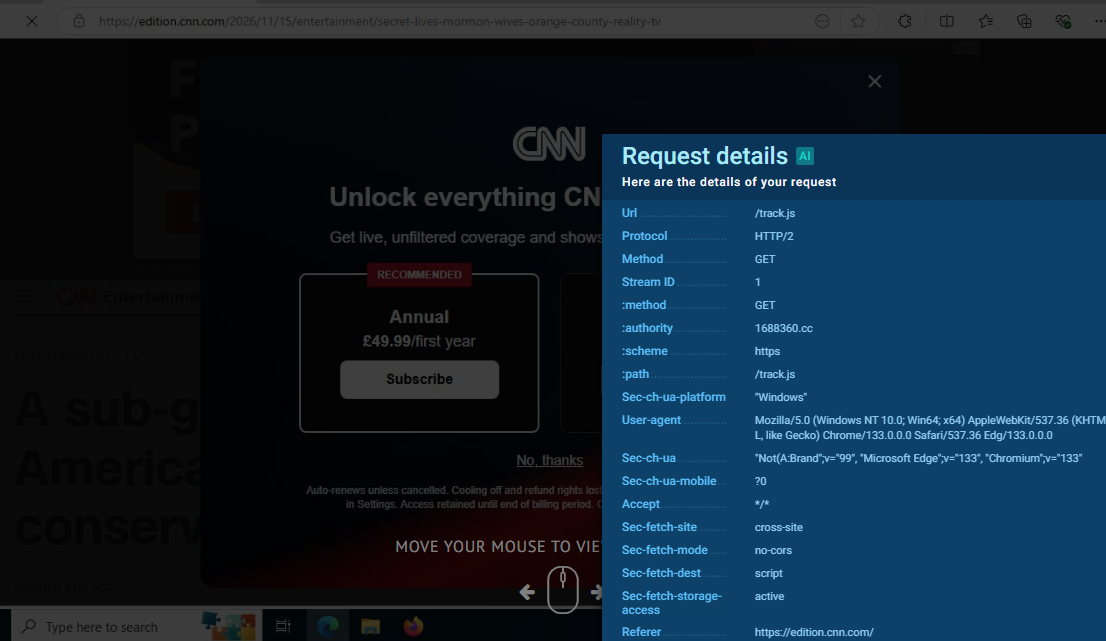
| 08:10 | First build of track.js, the malicious cryptocurrency clipper. |
| 08:28 | 1688360.cc/track.js first observed loading on bbc.com. |
| 11:20 | Zoom’s Optimizely snippet modified, reflected in its Last-Modified HTTP header. |
| 13:03 | Attacker sweeps stolen cryptocurrency to exchanges. |
| 13:43 | Credit card skimming functionality added to track.js, expanding the attack beyond cryptocurrency theft. |
| 16:38 | eil786npto9u5bq.icu registered as a second iOS exploit-kit router. |
| 17:13–17:57 | Second iOS host added. A Coruna exploit-kit iframe is injected into visits from iOS devices running iOS 18.6 or earlier. |
| 19:24–19:59 | Security researchers’ sweep identifies 186 of 1,611 Optimizely snippets as infected. |
| ~20:40–21:10 | Mass clean-up begins. Ledger is cleaned at 20:41, Smartsheet at 20:56 and BBC at 21:07. |
| 21:52 | One of 188 monitored snippets remains infected: TalkTalk. |
Indicators of Compromise (IOCs)
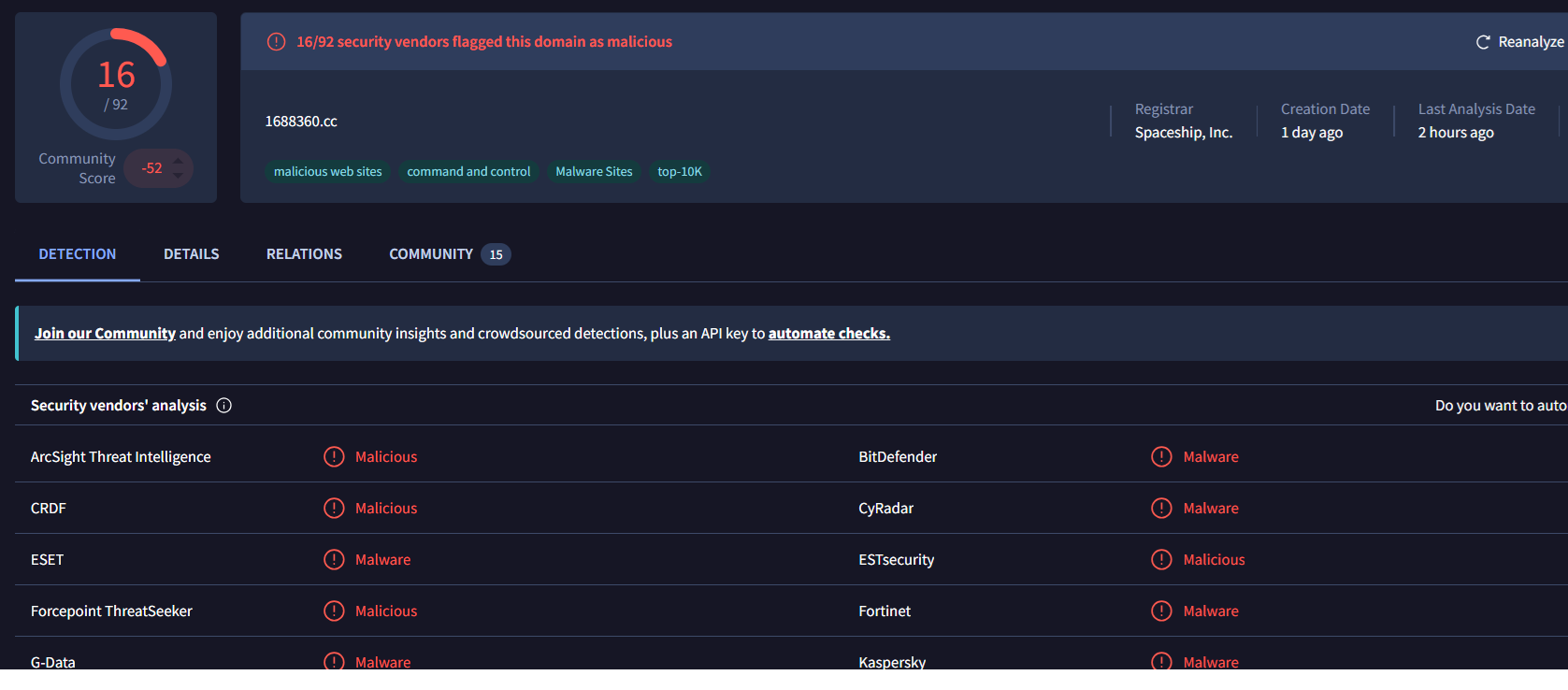
Organisations investigating potential exposure should consider the following indicators identified in the campaign.
Malicious URLs:
hxxps://1688360[.]cc/hit.phphxxps://1688360[.]cc/card.php
Malicious domains:
5vobauua3ojpklx[.]icueil786npto9u5bq[.]icu
The first domain was used to deliver the main malicious JavaScript payload and receive stolen information, including card details and browser data. The two .icu domains were associated with the iOS exploit-kit delivery infrastructure.
Organisations should consider searching web proxy, DNS, firewall, EDR and network telemetry for connections to these indicators.
What does this mean for organisations?
The incident is another reminder that an organisation’s external attack surface extends well beyond the infrastructure and applications it directly manages.
Third-party JavaScript platforms, analytics tools, advertising scripts, customer experience platforms and website experimentation services can all introduce code into customer browsers.
Even when an organisation’s own website infrastructure remains uncompromised, malicious modifications to a trusted third-party dependency can expose its customers to financial theft, session compromise and potentially device exploitation.
Organisations using Optimizely should review their JavaScript snippets and project-level custom JavaScript, verify that malicious code has been removed, and investigate historical access and network telemetry for signs of exposure.
The incident also highlights the importance of restrictive Content Security Policies (CSP), JavaScript integrity monitoring and monitoring unexpected third-party connections.
A wider warning for Australian and New Zealand customers
For Australian and New Zealand users, the concern is not limited to the international brands making headlines.
The affected list includes familiar local banking, financial services, telecommunications and retail websites. Customers who visited affected domains during the campaign should be mindful of what information they entered or copied while the malicious code was active.
Anyone who entered card details directly into affected website forms during the exposure window should consider contacting their financial institution, monitoring transactions and requesting a replacement card if advised.
Cryptocurrency users who copied wallet addresses while visiting affected sites should independently verify any transactions and destination addresses. Users should also consider reviewing account sessions and signing out of unfamiliar sessions where appropriate.
The key takeaway: A website does not need to be directly hacked for its customers to become victims of a cyberattack. Compromising a trusted third-party JavaScript dependency can turn legitimate, high-traffic websites into delivery mechanisms for financial theft and malware.