From Patch Release to Botnet Attack in 38 Hours: The Lifecycle of a Modern Vulnerability
The Race Against Time Has Already Been Lost
For years, security professionals have warned that the window between vulnerability disclosure and active exploitation is shrinking.
Recent events surrounding CVE-2026-41940 in cPanel provide a perfect case study of just how little time defenders now have to react.
What used to be measured in weeks is now measured in hours.
And as later investigations revealed, attackers may have already been exploiting the flaw months before the public knew it existed.
The Timeline
23 February 2026 – The Earliest Known Exploitation
Months before the vulnerability became public, evidence later showed that exploitation activity had already begun.
This is perhaps the most important date in the entire timeline.
While administrators, vendors, and security teams were unaware of the issue, threat actors appear to have already discovered and weaponized it.
By the time a CVE number existed, some attackers had already enjoyed a significant head start.
29 April 2026 – cPanel Releases a Security Update
05:05 AM
cPanel quietly released a security update addressing what would later be assigned CVE-2026-41940.
At this point, the vulnerability details were not widely known, but experienced researchers understand that every security patch contains clues.
For attackers and defenders alike, the race begins the moment a patch is released.
30 April 2026 – NIST Publishes the CVE
05:15 AM
Just over 24 hours later, the vulnerability was formally published in the NIST National Vulnerability Database.
The issue now had a public identifier, attracting the attention of researchers, security vendors, bug hunters, and threat actors around the world.
The spotlight was officially on.
30 April 2026 – Reverse Engineering Begins
05:19 AM
Only four minutes after the CVE became public, security researchers at WatchTowr published a detailed reverse-engineering analysis of the vulnerability.
This demonstrates the reality of modern vulnerability disclosure.
The moment a patch is available, researchers begin comparing patched and unpatched versions to determine exactly what was fixed.
This process, known as “patch diffing,” has become highly automated.
If white-hat researchers can reverse engineer a vulnerability within hours, it is reasonable to assume that gray-hat and criminal actors can do the same.
In many cases, they are already doing it.
The Feeding Frenzy Begins
30 April 2026 – Surge in cPanel Scanning
09:00 AM
Less than four hours after public disclosure, our firewall telemetry showed a significant increase in scanning activity targeting port 2087, one of the most common cPanel management ports.
This wasn’t exploitation yet.
This was reconnaissance.
Thousands of systems across the internet were being checked to identify potential targets before defenders had a chance to patch.
The hunting phase had begun.
Detection Tools Become Public
30 April 2026 – Vulnerability Scanner Released
06:21 PM
A vulnerability detection script was published on GitHub.
While intended to help administrators identify vulnerable systems, such tools inevitably lower the barrier to entry for attackers as well.
The same script that helps a defender audit their environment can help an attacker identify targets at scale.
At this stage, any remaining security through obscurity had effectively disappeared.
The Botnets Arrive
30 April 2026 – Mirai Activity Explodes
07:00 PM
Approximately 38 hours after the original security update was released, our firewall logs recorded the beginning of a massive attack wave.
More than 25,000 unique IP addresses associated with the Mirai botnet began smashing against our firewall targeting close telnet ports. The botnet was searching for more members to add to its numbers.
We checked several other organisations and staff members home firewalls and everyone was seeeing the same traffic patterns.
The most sobering detail?
Many of these attacking systems appeared to be compromised cPanel servers themselves.
Victims from the first wave had become the launch platform for the second.
This is how internet-scale compromise accelerates.
Every newly infected system becomes another soldier in the botnet, increasing scanning, exploitation, and propagation rates.
What This Timeline Tells Us
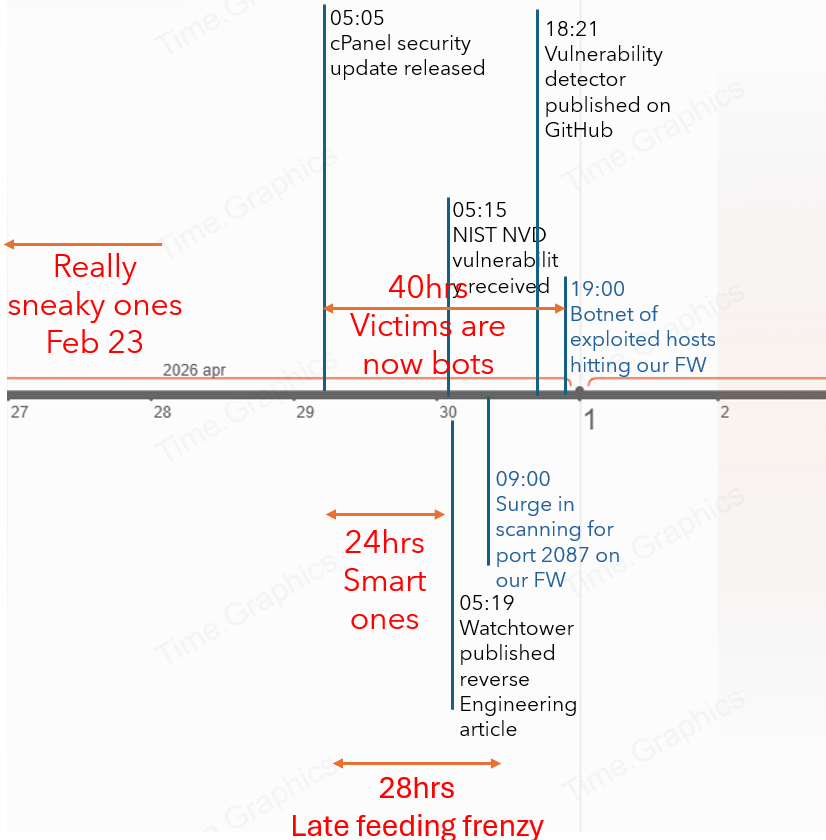
The timeline reveals several uncomfortable truths about modern cybersecurity.
1. Attackers May Know Before Defenders
Evidence of exploitation dating back to February suggests that some threat actors discovered the vulnerability long before public disclosure.
The first public patch is often not the beginning of the story.
It’s simply the moment everyone else catches up.
2. Reverse Engineering Happens Immediately
The days of “security through patch secrecy” are over.
Attackers no longer need vulnerability details from advisories.
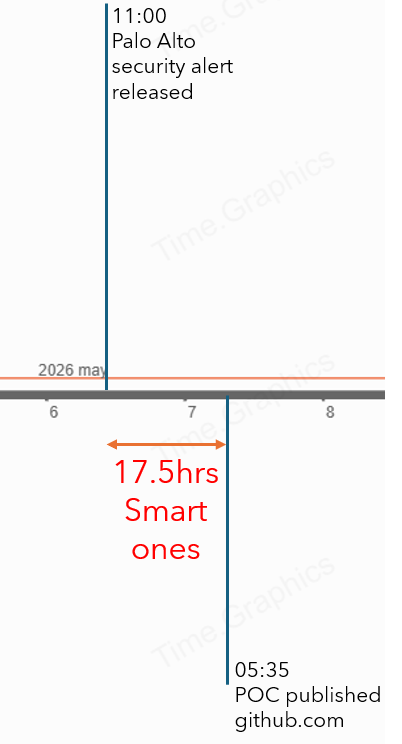
They can extract them directly from the patch itself. Below is the timeline for a Palo Alto vulnerability released the same week where it was only 17 1/2 hours before a security company published the POC on their GitHub site.
3. Internet-Wide Scanning Starts Within Hours
The spike in port 2087 scanning demonstrates how quickly threat actors mobilize after disclosure.
Every exposed service becomes a target almost immediately.
4. Public Detection Tools Accelerate Weaponization
Defensive tools are important, but once released publicly, they also provide attackers with a roadmap.
The timeline from disclosure to mass exploitation continues to compress.
5. Botnets Move Faster Than Patch Cycles
Many organisations still patch monthly.
Attackers now operate on timelines measured in hours.
That gap is becoming increasingly dangerous.
The New Reality
A decade ago, administrators often had days or weeks to react to a newly disclosed vulnerability.
Today, that assumption is no longer valid.
For internet-facing systems:
- Patch release is Day Zero.
- Reverse engineering begins immediately.
- Scanning follows within hours.
- Mass exploitation can begin the same day.
- Botnets arrive shortly afterwards.
The question is no longer:
“How quickly can attackers weaponize a vulnerability?”
The answer is clear.
They already have.
The real question is:
“Can defenders patch faster than attackers can automate?”
As CVE-2026-41940 demonstrates, the window for doing so may now be measured in hours rather than days.